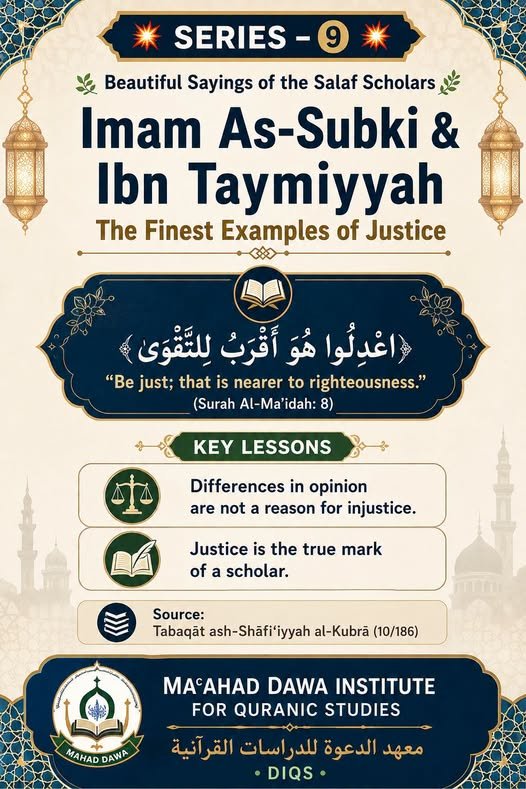
💥## Between Al-Subki and Ibn Taymiyyah.. Glorious Stances of Justice and Fairness💥
Among the finest virtues of the people of knowledge and religion are fairness and recognizing the merit of those who deserve it. They do not diminish the rights of those who disagree with them; rather, they clarify the mistakes of the opponent and refute them, yet they acknowledge their knowledge and virtue. This is in adherence to the saying of the Truth, Exalted and Glorified be He:
"And let not the hatred of a people lead you to not be just. Be just; that is nearer to righteousness…" [Al-Ma'idah: 8].
Indeed, one of the worst things we have witnessed on social media in recent times is the emergence of groups whose sole concern is to defame their opponents and diminish their status. We have even seen some self-proclaimed Salafis declaring Ash'aris to be disbelievers (Kuffar) and slandering the two eminent Imams, Al-Nawawi and Ibn Hajar, even recommending that their books be burned.
On the other hand, a group of fanatical Ash'aris—particularly those affiliated with Al-Azhar University—has emerged with no concern other than slandering those who adhere to the methodology of the Pious Predecessors (Salaf), labeling them as "renegades" (Nabita), "Wahhabis," and ignoramuses who have no right to speak about religion. It even reached the point where one of them explicitly stated that he would file lawsuits against anyone who insulted him or crossed the line with him.
When it was said to him, "You are going to file a lawsuit against so-and-so who did not insult you, but merely offered a calm, academic refutation?" he replied, "I will sue him for violating the law regulating Fatwa (religious edicts), because he spoke about religion and he is not an Azhari!"—among other things that are witnessed and known to anyone who follows these platforms.
In such an atmosphere, it is beneficial to recall some of the stances of our pious predecessors among the people of knowledge in dealing with their opponents, so that we may learn from them and follow their example.
I have chosen to speak about two eminent contemporary scholars: Taqi al-Din ibn Taymiyyah and Taqi al-Din al-Subki, may Allah Almighty have mercy on them both. Ibn Taymiyyah, as is well known, followed the methodology of the Salaf and Ahl al-Athar (People of Hadith), while Al-Subki followed the Ash'ari methodology.
1. As for Ibn Taymiyyah (661 – 728 AH)
I have demonstrated in previous articles aspects of his conduct with his opponents among the Ash'aris and others, and how, despite his strong refutations against them, he recognized their rights and virtues.
A prime example of this is his stance when Sultan Al-Nasir Muhammad bin Qalawun sought his religious verdict (Fatwa) regarding executing certain scholars and judges who opposed him—meaning they opposed Ibn Taymiyyah—and who had previously caused him severe harm and had also issued verdicts to depose that very Sultan. However, Ibn Taymiyyah did not comply with the Sultan's request. Instead, as his student Ibn Kathir mentions in [البداية والنهاية – Al-Bidayah wa al-Nihayah: 14/56],
He began to praise and highly commend those judges and scholars, saying to the Sultan: "If you kill these people, you will not find anyone like them after them." When the Sultan said to him, "They harmed you and wanted to kill you repeatedly," the Sheikh replied: "Whoever harmed me is pardoned, and whoever harmed Allah and His Messenger, Allah will take vengeance upon him, but I do not avenge myself." He kept persuading the Sultan until the Sultan became clement and pardoned them.
Another example is his statement after mentioning a group of Ash'ari scholars, such as Abu Bakr al-Baqillani, Abu al-Ma'ali al-Juwayni, and others:
"Furthermore, there is not one among them except that he has commendable efforts in Islam, and righteous deeds, and he has—in refuting many of the people of atheism and innovation and in championing many of the People of Sunnah and religion—what is not hidden to anyone who knows their conditions and speaks about them with knowledge, truthfulness, justice, and fairness. However, when this principle, which was originally taken from the Mu'tazilah—meaning the denial that Allah's actions subsist in His Essence—became confusing to them, and they were virtuous and intelligent men, they found it necessary to apply it consistently and adhere to its implications. Consequently, they were bound to views that the Muslims among the people of knowledge and religion denounced. Because of this, people split regarding them: some venerate them due to their merits and virtues, while others censure them due to the innovations and falsehood found in their speech. The best of matters is the middle ground. This is not exclusive to them; rather, similar instances occurred to groups among the people of knowledge and religion. May Allah Almighty accept the good deeds of all His believing servants and overlook their misdeeds: 'Our Lord, forgive us and our brothers who preceded us in faith and put not in our hearts [any] resentment toward those who have believed. Our Lord, indeed You are Kind and Merciful.' There is no doubt that whoever strives to seek the truth and religion from the path of the Messenger ﷺ and errs in some of that, Allah will forgive his error…"
[درء تعارض العقل والنقل – Dar' Ta'arud al-Aql wa al-Naql (2/102)]
2. As for the Judge Ali bin Abd al-Kafi al-Subki (683 – 756 AH)
He adhered to the Ash'ari creed, as we mentioned, and was highly critical of Ibn Taymiyyah and his followers regarding matters of creed and other issues. Nevertheless, I found stances of his that demonstrate his fairness and justice, which we hope will serve as an example for the followers of the Ash'ari methodology in our contemporary era.
Among these is what his son, Taj al-Din al-Subki, mentioned in his book [طبقات الشافعية – Tabaqat al-Shafi'iyyah (10/398)] in the biography of the Hadith master Jamal al-Din al-Mizzi. He narrated that his father, Sheikh Taqi al-Din al-Subki, told him that when he assumed the position of Chief Shafi'i Judge in Damascus in the year 739 AH, one of the Ash'ari scholars, "Sadr al-Din al-Maliki," came to him and requested that he dismiss Al-Mizzi from the leadership of the Ashrafiyyah Dar al-Hadith school. Sadr al-Din requested this solely because Al-Mizzi did not adhere to the Ash'ari creed; rather, he was a companion and close associate of Sheikh al-Islam Ibn Taymiyyah and held his creed. In fact, when Al-Mizzi was previously imprisoned, Ibn Taymiyyah was deeply pained by it, went to the prison, and released him himself, as recorded in [البداية والنهاية – Al-Bidayah wa al-Nihayah: 14/39].
Al-Dhahabi said of Al-Mizzi in
[تذكرة الحفاظ – Tadhkirat al-Huffadh (4/1499)]:
"He and Ibn Taymiyyah accompanied each other closely in hearing Hadith and examining knowledge, and he used to establish the way of the Salaf regarding the Sunnah…"
Al-Mizzi is the one who said concerning Ibn Taymiyyah:
"I have not seen the likes of him, nor has he seen the likes of himself. I have not seen anyone more knowledgeable of the Book of Allah and the Sunnah of His Messenger ﷺ, nor anyone who followed them more closely than him."
[الرد الوافر – Al-Radd al-Wafir by Ibn Nasir al-Din, p. 213]
However, Sheikh Taqi al-Din al-Subki refused to dismiss Al-Mizzi. Instead, he said to his son while recounting this incident:
"My skin shuddered, my mind was overwhelmed, and I said to myself: 'This is the Imam of the Hadith scholars! By Allah, if Al-Daraqutni were alive, he would feel ashamed to teach in his place.'"
The reason for this noble stance by Al-Subki was that he knew the condition stipulated by the founder of that school was that its leadership must be held by the most knowledgeable person in Hadith—both in terms of narration (Riwayah) and comprehension (Dirayah)—among the jurists of the Shafi'i school. Al-Mizzi was the most deserving person to whom that condition applied at the time.
Later, when the Hadith master Al-Mizzi passed away (in the year 742 AH), Taqi al-Din al-Subki appointed the Hadith master Al-Dhahabi to the leadership of that school, as mentioned by his son Taj al-Din al-Subki in [طبقات الشافعية – Tabaqat al-Shafi'iyyah (10/200)]. Al-Dhahabi was also not of the Ash'ari school; rather, he was among the students and admirers of Ibn Taymiyyah. For this reason, this appointment was met with rejection by the Ash'ari sheikhs of the Levant (Sham), who complained to the deputy of the Sultanate, resulting in Al-Subki himself ultimately taking over the leadership of the Ashrafiyyah Dar al-Hadith.
This stance by Sheikh Taqi al-Din al-Subki in his refusal to dismiss the Hadith master Al-Mizzi, as well as his stance in appointing Al-Dhahabi, clearly demonstrates his fairness, may Allah have mercy on him. Despite his disagreement with them on certain matters of creed, and despite them being supporters of Ibn Taymiyyah—with whom he had severe disputes—this did not prevent him from recognizing merit for those who possessed it and putting forward whoever deserved precedence. In fact, it was Taqi al-Din al-Subki himself who led the funeral prayer (Janazah) over Al-Mizzi, as mentioned by the Hadith master Ibn Kathir in [البداية والنهاية – Al-Bidayah wa al-Nihayah (14/204)].
May Allah have mercy on them all and forgive us and them through His grace, virtue, and generosity.
Dr. Abd al-Akhir Hammad
✍️ Translated by
Usthadh SM .Ismail Nadwi