💥 Series – 3️⃣
((Ashura and Imam Husayn))
🌿 False Criticisms in the Name of Imams and Their Refutations 🌿
📖 "The Tragedy of Karbala and the Day of Ashura: Imam Ibn Taymiyyah's Balanced Perspective and Historical Evidences!"
Research Source Document:
يوم عاشوراء في تراث ابن تيمية رحمه الله
(Salaf Center for Research and Studies)
Compiled Translation:
With original text citations from the works of Ibnu Taymiya Rahimahullah
To read in Arabic 👇(https://1drv.ms/b/c/7b9658e3ebdf7324/IQDTEEfE6c8TQKSV-uf9Rnl9AQSCqe3C0FKk4oDTlAGbLRQ)
1. Introduction:
The Academic Eminence and Moderation of Shaykh al-Islam
As German researcher Anke von Kügelgen notes in the introduction to her extensive study titled "Ibn Taymiyyah's Critique of Aristotelian Logic and His Counter-Project": "Ibn Taymiyyah—by the consensus of his detractors and supporters alike—was a personality of a grand stature; he was a jurist (faqih) and a theologian critic of Aristotelian logic and Sufism on one hand, and an exceptional critic and moral researcher .
His contemporary and later monumental historians, such as Imam Ibn Kathir, Badr al-Din al-Ayni, Ibn Daqiq al-Eid, and Ibn Sayyid al-Nas, have praised his unparalleled memory and his intense adherence to the Quran and Sunnah.
The Day of Ashura is a day that carries numerous historical turning points and intense theological and jurisprudential content within the Muslim community.
The objective of this research is to dispel the extreme innovations (bid'ah) introduced by Shythan surrounding this day and to revive its pure Sunnah .
2. The Martyrdom (Shahadah) of Imam Husayn (may Allah be pleased with him):
The Precise Theological Perspective of Ibn Taymiyyah
Demolishing the historical slander that Shaykh al-Islam Ibn Taymiyyah harbored hatred toward the Ahl al-Bayt (the Prophet's family), he has recorded highly profound and deeply moving analyses regarding this great historical tragedy.
A) The Unjust Killing and Severe Censure Upon the Killers:
Imam Ibn Taymiyyah categorically proclaims that Imam Husayn (may Allah be pleased with him) was oppressed and unjustly martyred (mazluman shahidan) at the battlefield of Karbala. He severely censures the transgressors who perpetrated his murder.
"Whoever killed Husayn, aided in his killing, or was pleased with that, then upon him is the curse (la'nah) of Allah, the angels, and all of mankind; Allah will not accept from him any mandatory (sarf) or optional (adl) act of worship on the Day of Resurrection." (Source: Majmu' al-Fatawa 4/487; Document Pages: 11, 13)
B) The Purpose of Martyrdom — The High Status Granted by Allah:
Imam Hasan and Imam Husayn are the two leaders of the youth of Paradise. Both of them were born during the glorious period of Islam and grew up in absolute honor, ease, and dignity without facing severe hardships.
As the Prophet ﷺ stated:
"The people most severely tested are the Prophets, then the righteous, then the next best, then the next best." Therefore, to grant them the lofty stations of the martyrs (shuhada), Allah decreed this testing and martyrdom for Husayn (may Allah be pleased with him)This was a blessing from Allah to elevate their status to that of their noble predecessors
. (Source: Al-Fatawa al-Kubra 1/196-170;
C) The Journey to Karbala and the Treachery of the People of Kufa:
The people of Kufa wrote thousands of letters to Imam Husayn, promising allegiance and support, but betrayed him at the critical moment.
Senior Companions like Ibn Abbas and Ibn Umar (may Allah be pleased with them) advised him against leaving, yet he departed for Kufa in accordance with the divine decree .
Upon realizing the betrayal at Karbala, Husayn (may Allah be pleased with him) offered three just options: "Let me return to where I came from (Medina), or let me go to one of the borderlands to guard, or let me go to my cousin Yazid." However, the tyrannical governor Ibn Ziyad and his army refused these terms and demanded his unconditional surrender.
Refusing humiliation, Imam Husayn fought bravely until he was unjustly martyred . (Source: Al-Fatawa al-Kubra 1/199-200)
3. Historical Refutation of the Slander Against Muawiyah (may Allah be pleased with him)
In modern times, out of historical ignorance, some falsely claim that Muawiyah (may Allah be pleased with him) committed injustice against Imam Husayn
Ibn Taymiyyah’s historical verifications completely refute this.
- Chronological Discrepancy:
The martyrdom of Imam Husayn (may Allah be pleased with him) at Karbala did not occur during the reign of Muawiyah (may Allah be pleased with him).
Rather, it took place after his passing, during the reign of Yazid bin Muawiyah in the year 61 AH .
- The Transgressing Sect:
The ones who murdered Husayn (may Allah be pleased with him) were Ubaydullah bin Ziyad and his tyrannical, oppressive faction (al-ta'ifah al-zalimah al-baghiyah) at Karbala, not Muawiyah.
Muawiyah (may Allah be pleased with him) had absolutely no connection to this event
(Source: Al-Fatawa al-Kubra 1/199-200)
4. The Two Extreme Innovations (Bid'ah) Born on the Day of Ashura
Following the martyrdom of Imam Husayn (may Allah be pleased with him), Satan split the Muslim community by engineering two diametrically opposed innovations originating from Kufa.
A) The Shia Innovation of Mourning (Bid'at al-Huzn wa al-Nuh):
The Shia turned the Day of Ashura into a day of public mourning, grieving, and lamentation over the tragedy of Karbala .
- Practices:
Slapping the cheeks, tearing clothes, self-inflicted thirst, reciting sorrowful poetry, and practicing niyaha (wailing)—all of which belong to the days of ignorance (Jahiliyyah) banned by the Prophet ﷺ .
- Ibn Taymiyyah's Refutation:
Mourning past tragedies annually has no place in the religion of Islam.
When Imam Ali (may Allah be pleased with him) was assassinated, neither Imam Husayn nor his family established an annual day of mourning . No such thing was done upon the death of the Prophet ﷺ eeithe. Furthermore, this mourning is used as a tool to abuse the noble Companions, incite sectarian hatred, and breed fitnah.
This is a severely condemned misguidance
(Source: Iqtida al-Sirat al-Mustaqim 2/129-131)
B) The Joyous Innovation of the Ignorant Nawasib (Bid'at al-Surur wa al-Farah):
In direct opposition to the mourning innovations, the 'Nawasib' (those who harbored hatred against the Ahl al-Bayt) and the ignorant masses transformed Ashura into a celebratory festival.
- Practices:
Taking a ritual bath, applying kohl (kuhl) to the eyes, applying henna, wearing new garments, spending lavishly on the family (tawsi'ah), and cooking special grains (hubub).
- Ibn Taymiyyah's Clarification:
The narration stating "Whoever spends generously on his family on the Day of Ashura, Allah will enrich him for the rest of the year" is an absolute fabricated (mawdhu') and a lied narration
Similarly, claims that bathing on this day prevents sickness or applying kohl prevents eye pain are complete fabrications.
All four major Imams (Abu Hanifah, Malik, al-Shafi'i, and Ahmad) declared these celebratory practices to be reprehensible innovations
Countering falsehood with falsehood or innovation with innovation is completely un-Islamic
(Source: Al-Fatawa al-Kubra 1/194, 25/312-313)
5. Jurisprudence of the Ashura Fast and Opposing the Jews
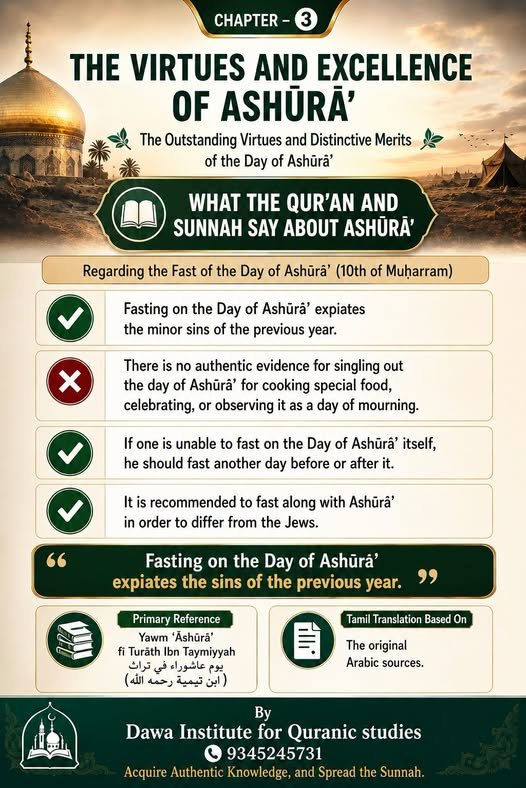
- Virtue of the Fast:
The fast of Ashura expiates the minor sins (sagha'ir) of the past year only; major sins require sincere repentance (tawbah)
(Source: Mustadrak 'ala Majmu' al-Fatawa 3/126)
- Opposing the Jews:
Initially mandatory (wajib), this fast became voluntary after Ramadan was prescribed.
While fasting Ashura alone is not disliked, the Prophet ﷺ established the final Sunnah to fast the 9th day (Tasu'a) along with it specifically to oppose the practices of the Jews
. (Source: Al-Fatawa al-Kubra 5/378, Majmu' al-Fatawa 25/311;
📌 References from the Original Works of Imam Ibn Taymiyyah
| Matter / Viewpoint | Reference to the Work of Ibn Taymiyyah |
| History and reasons behind the unjust killing of Imam Husayn | Al-Fatawa al-Kubra (الفتاوى الكبرى) Vol. 1, pp. 199-200 | Page: 12
| The high status of Imam Husayn and the purpose of his martyrdom | Al-Fatawa al-Kubra (الفتاوى الكبرى) Vol. 1, pp. 196-170 |
| Censure and invocation against the killers of Imam Husayn | Majmu' al-Fatawa
(مجموع الفتاوى) Vol. 4, p. 487 | Pages: 11, 13
| Shia practices of mourning and wailing declared as an innovation | Iqtida al-Sirat al-Mustaqim (اقتضاء الصراط المستقيم) Vol. 2, pp. 129-131 |
| Fabricated nature of narrations on celebration, kohl, bathing, and extra spending | Al-Fatawa al-Kubra (الفتاوى الكبرى) Vol. 1, p. 194 / Vol. 25, pp. 312-313 |
| The fast of Ashura expiates minor sins only | Mustadrak 'ala Majmu' al-Fatawa Vol. 3, p. 126 |
| Opposing the Jews and the Sunnah of fasting the 9th day along with the 10th | Majmu' al-Fatawa (مجموع الفتاوى) Vol. 25, p. 311 |
6. Conclusion:
Moderation (Wasatiyyah) is the Sunnah
The ultimate conclusion of Imam Ibn Taymiyyah’s extensive verifications is that Muslims must adhere to absolute moderation.
. Mourning and striking oneself has no place in Islam, nor does celebrating it as an Eid.
The singular, pure guidance established by the Prophet ﷺ and his Rightly Guided Caliphs is nothing other than observing the fast on the 9th and 10th days of Muharram.
✍️ Compiled by
Ustadh SM. Ismail Nadwi