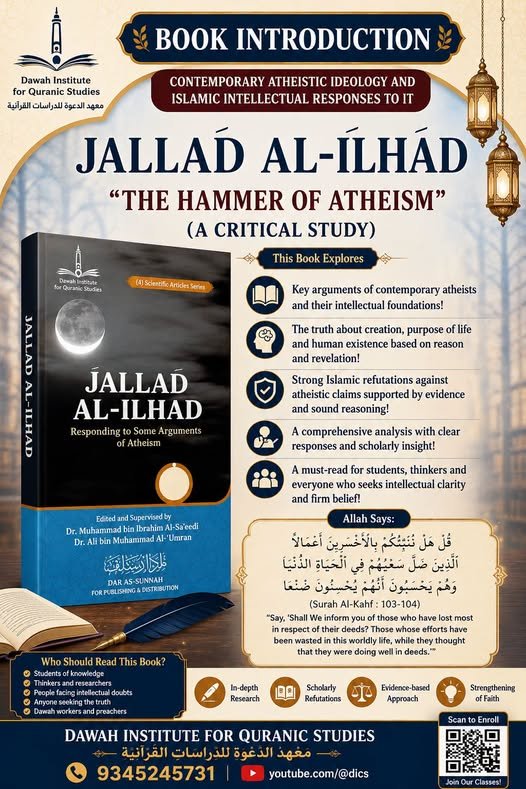
🌿 Book Introduction 🌿
Contemporary Atheism and Islamic Intellectual Responses to It:
جلاد الإلحاد
"Jallad al-Ilhad"
(The Sledgehammer of Atheism) – An Analysis
Introduction:
In the current era of science and technology, atheistic ideas and doubts are spreading rapidly among the youth in the name of human rationalism. Dazzled by Western scientific advancements, a misconception has arisen in many minds that religious beliefs are unnecessary. In this context, this book, "Jallad al-Ilhad" (جَلادُ الإِلْحَادِ – The Sledgehammer of Atheism), serves as a highly significant research compilation that provides intellectual and logical answers to the primary doubts and philosophical questions raised by contemporary atheists in the light of the Quran, Sunnah, and Islamic fundamentals. This book has been published by the 'Salam Centre for Research and Studies' (سلم للبحوث والدراسات)
To read this book in the Arabic language 👇
[https://1drv.ms/b/c/7b9658e3ebdf7324/IQBETYdTlXbmSIaRFieKih7RAcAmZrWhqGgs1ty5axq-EJU]
Key Features of the Book:
- Rational and Scientific Approach:
Instead of being mere emotional propaganda, this book refutes atheism through modern scientific theories (e.g., quantum physics, laws of thermodynamics) and logic.
- Solutions to Contemporary Doubts:
It provides very clear explanations for questions frequently raised by modern atheists and Orientalists, such as "Who created God?" and "If God is free of need, why should we worship Him?
- Balance Between Two Sides:
It very precisely distinguishes and demonstrates the relationship between divine decree (Pre-determination) and human free will.
- Explaining the Limitations of Science:
This book proves that empirical or experimental science is only helpful in understanding how the universe functions, but it lacks the capacity to discover the purpose behind the creation of the universe.
Major Topics Featured in the Book:
1. Initial logical proofs for the existence of God (الدلالات الأولية على وجود الله)
2. Innate human nature (Fitrah) and the existence of God.
3. Islamic theologians (Mutakallimoon) and the innate knowledge about God.
4. Proofs of creation and origination (Debate with atheists)
5. The order, precision of the universe, and the existence of God.
6. Human free will and the proof for the existence of God.
7. The ultimate destiny of human beings and the existence of God.
8. Moral values and the existence of God.
9. A detailed analysis of the atheistic doubt: "Who created God.
10. Limitations of Empirical Science (قصور العلم التجريبي).
11. What is the necessity of Prophets for mankind?
12. If God is free of need, why does He command us to worship Him?
13. Did God create the Kuffar (disbelievers) merely to punish them?
Detailed Explanation of Key Topics:
1. Limitations of Empirical Science (قصور العلم التجريبي):
Atheists consider science alone to be the ultimate truth. However, science can only explain "how a thing happens" (How), but it cannot answer philosophical questions regarding "why it happens and what is its purpose" (Why). For instance, science will state how the universe expands, but it cannot explain the purpose of why it was created. Therefore, to discover ultimate truths, human beings also require other sources such as intellect, senses, and divine revelation (Wahy).
2. "Who Created God?"
(فمن خلق الله؟):
This is a logical fallacy of a question asked most frequently by the atheistic world. Islamic logic explains this as follows: Everything in the universe has a "beginning and an end" (Hadith), so they require a creator. However, God, the absolute first cause who created everything, is "without beginning and without end, eternally existing" (Wajib al-Wujud). Asking "who created" someone who is uncreated is itself logically flawed. The chain of cause and effect (Infinite Regress) must stop at one point, and that point is God.
3. Moral Values and the Existence of God (النزعة الأخلاقية ووجود الله):
Human beings naturally perceive justice, truth, and mercy as good qualities, and injustice, lies, and betrayal as evil traits. Where did this universal moral consciousness (Objective Morality) come from to humans? If a human is merely a combination of atoms according to atheistic theory, why should this moral consciousness exist within him?These values are sown within mankind by God. The existence of God becomes necessary to provide a complete moral law.
✍️ Compilation
Ustadh SM Ismail Nadwi